Seeing Reality Clearly: Buddhism and the Nature of Awakening

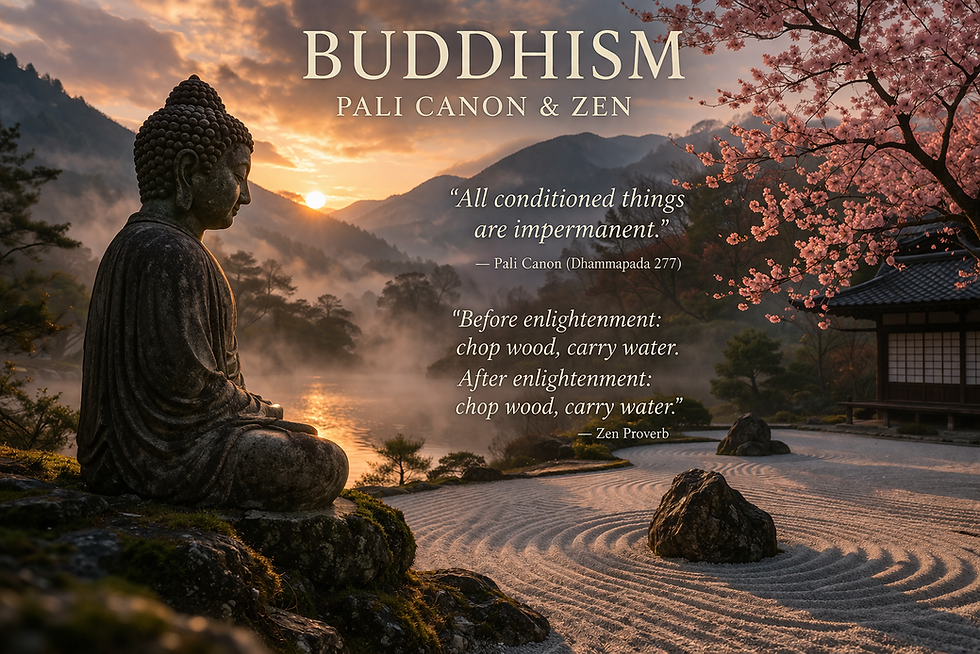
We suffer not because reality is hostile, but because we misread it.
This is one of the most radical—and liberating—insights at the heart of Buddhism. It challenges a deeply held assumption: that pain, struggle, and dissatisfaction are caused by the world itself. Instead, Buddhism suggests something far more unsettling and empowering—our experience of reality is shaped by how we perceive it, not by what it inherently is.
Tradition Overview
Buddhism teaches that life as we ordinarily experience it is samsara—a cycle of suffering, repetition, and dissatisfaction. This cycle is driven by three core forces:
Ignorance (avijjā) – not seeing reality clearly
Craving (tanhā) – grasping for what we want
Attachment to self (atta) – believing we are fixed, separate identities
We move through life interpreting everything through these filters. We chase what feels good, resist what feels bad, and build identities around both. Over time, this creates a loop of perception that feels real—but is actually constructed.
Enlightenment (nirvana) is not about escaping the world. It is about seeing through the distortion. It is the moment when reality is experienced directly, without the overlays of fear, desire, and identity.
Illusion / Entrapment
In Buddhism, the illusion is not that the world doesn’t exist—it’s that we misinterpret it constantly.
We believe:
“This will make me happy forever.”
“This pain will last forever.”
“This is who I am.”
But these are projections, not truths.
The mind is always labeling, judging, comparing, and predicting. It creates a version of reality based on past experiences and future fears. This process feels automatic—and it is—but it also creates suffering.
We become enslaved by craving and aversion, pulled toward what we want and pushed away from what we fear. At the same time, we cling to a sense of self that feels solid and permanent, even though it is constantly changing.
Impermanence: The Nature of Reality
At the core of Buddhist teaching is a simple but profound truth: everything is impermanent (anicca).
Emotions arise and pass
Thoughts come and go
Relationships change
The body ages
Even identity is in flux
Yet we live as if things should be stable, predictable, and lasting. We try to hold onto what is slipping away and resist what is already changing.
This is where suffering is born.
Impermanence is not a flaw in reality—it is reality. The problem is not that things change. The problem is that we expect them not to.
When you begin to truly see impermanence—not just intellectually, but experientially—something shifts. The urgency to grasp softens. The fear of loss loosens. Life becomes more fluid, less rigid, more alive.
The Nature of Self: Not What You Think
Another core insight in Buddhism is non-self (anatta).
What we call “self” is not a fixed entity—it is a constantly changing process made up of:
Thoughts
Emotions
Sensations
Memories
Conditioning
There is no solid “you” behind it all—only experience unfolding moment by moment.
This can feel destabilizing at first. But it is also profoundly freeing. If the self is not fixed, then neither are your limitations, your fears, or your past.
You are not trapped—you are in motion.
Path to Liberation
Buddhism offers a practical path for waking up from this cycle of misperception.
Through:
Meditation
Mindfulness
Insight practices (vipassanā)
You begin to observe the mind instead of being controlled by it.
You notice:
Thoughts arise without your control
Emotions move through like waves
Cravings intensify, peak, and dissolve
Over time, this observation breaks the illusion that these experiences define you.
You stop reacting automatically. You stop clinging so tightly. You begin to see reality more clearly.
And in that clarity, suffering begins to dissolve.
A Different Relationship to Reality
Awakening in Buddhism is not about becoming someone new. It is about relating to reality differently.
Instead of grasping → you allow
Instead of resisting → you observe
Instead of identifying → you witness
Reality doesn’t have to change for suffering to end. Your relationship to it does.
Takeaway: Practice Seeing Clearly
Start simply.
Notice where your mind:
Clings to outcomes
Judges experiences
Projects meaning onto neutral events
And instead of fighting those thoughts, try this:
Watch them.
Let them move through your awareness like clouds drifting across the sky—appearing, shifting, dissolving.
You don’t have to believe every thought. You don’t have to follow every feeling.
In that space between perception and reaction, something powerful emerges:
Freedom.


Comments